This course is designed as an advanced course in Structural Equation Modeling (SEM) for existing AMOS and/or Mplus users.
Instructor

Mr Philip Holmes-Smith (OAM) is the Director of School Research, Evaluation and Measurements Services (SREAMS), an independent educational research consultancy business. His research, evaluation and measurement interests lie in the areas of teacher effectiveness and school improvement, accountability models and benchmarking, improving the quality of teaching, using student performance data to inform teaching, and large-scale achievement testing programs. He is an experienced teacher of social science research methods and is a regular instructor at the ACSPRI programs. He also regularly teaches Structural Equation Modeling (SEM) and Multi-Level Analysis (MLA) at various universities around Australia.
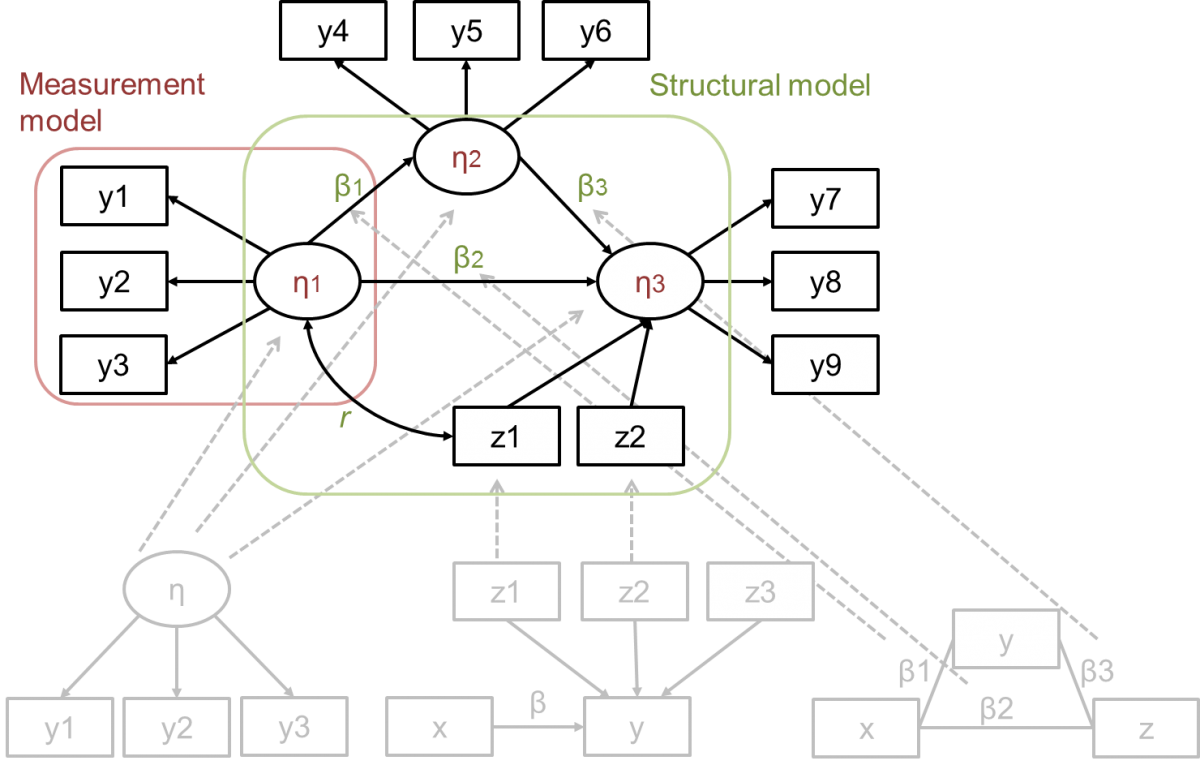
Introductory courses typically cover path analysis amongst observed variables, confirmatory factor analysis, and full SEM models with latent variables. This course covers a number of more complex models including models with mediating variables, models with interactions (moderation), ANOVA and ANCOVA models for latent outcomes, multi-level models (including repeated measures models) and mixture models.
Furthermore, introductory courses usually deal only with continuous, normally distributed variables. This course addresses the treatment of non-normal data and covers the analysis of observed categorical variables including ordered categorical (ordinal) variables such as Likert scales and unordered categorical (nominal) variables that may be binary (Male/Female, Problem Gambler/Non Gambler, Smoker/Non-Smoker, etc.) or polynomial (Australian/Indonesian/South African, etc.)
Detailed notes with worked examples and references will be provided as a basis for both the lecture and hands-on computing aspect of the course.
The target audience for this course is existing AMOS and/or Mplus users.
(N.B. Although the instructor will teach and use both packages throughout the course, students may choose to to work with just one of the packages or they may choose to work with both).
Day 1
Part A - An AMOS and/or Mplus refresher through revision of some basic models. This part of the course provides an opportunity to refresh your AMOS and/or Mplus programming skills by running some basic models and reviewing the output.
Part B - Revision of basic concepts. This part of the course is a revision of several issues related to fitting structural equation models. Topics include a revision of model conceptualisation, assessing model fit, the treatment of missing data, the treatment of outliers, model fit for skewed data (Mplus: Satorra-Bentler χ² and robust standard errors; AMOS: Bollen-Stine adjusted p and bootstrapped standard errors), constraining parameters, non-positive definite matrices, negative error variances, unidentified and inadmissible models.
Day 2
Part A – Dealing with non-continuous dependent variables. Topics include, regression models for non-continuous dependent variables (Probit, Logistic, and Multinomial logistic regression for categorical dependent variables); Poisson regression for count dependent variables; Censored regression for censored dependent variables, and CFA models with categorical factor indicators.
Part B - Constructing composite variables for use in structural equation models. This part of the course includes a revision of one-factor congeneric measurement modeling which is then extended to introduce the Holmes-Smith & Rowe approach to using composite variables in SEM. This topic also covers reliability and validity of composites created from one-factor congeneric measurement modeling.
Day 3
Advanced single-level models. Topics include the testing of model and parameter invariance across groups (multi-group analysis), analysis of interactions with both categorical and continuous moderator variables, mediation vs. moderation, non-linear modeling, and mean structure analysis approaches to the Analysis of Covariance.
Day 4
Multi-level analysis and mixture models. Introduction to the use of multilevel models to analyse data from hierarchically structured populations/samples (e.g., voters nested within electorates, students nested within classes within schools, employees nested within work groups within companies, etc.), or longitudinal studies (repeated measures nested within individuals). Day 4 topics will focus on Multi-level regression and multilevel SEM models.
Day 5
Multi-level analysis and mixture models (cont). Day 5 will focus on the analysis of longitudinal data using latent growth curve modeling. Mixture modeling, including latent class analysis and regression mixture modeling, will also be introduced.
Participants must have completed an introductory course in Structural Equation Modeling using an SEM program such as AMOS or Mplus. However, it is NOT assumed that all participants have had experience in BOTH AMOS and Mplus – both will be taught as part of the course.
References include:
- Arbuckle, James L. (1983-2022). IBM SPSS AMOS 29 User’s Guide. IBM Corp.
- Muthén, L.K. and Muthén, B.O. (1998-2017). Mplus User’s Guide. Eighth Edition. Los Angeles, CA: Muthén & Muthén.
- Byrne, Barbara M. (2016). Structural Equation Modeling with AMOS: Basic Concepts, Applications, and Programming. (3rd Ed.) New York: Routledge Academic.
- Byrne, Barbara M. (2012). Structural Equation Modeling with Mplus: Basic Concepts, Applications, and Programming. New York: Routledge Academic.
- Kline, Rex B. (2023). Principles and Practice of Structural Equation Modeling (5th Ed.). New York: Guilford Press.
The instructor's bound, book length course notes will serve as the course texts.
Very knowledgeable instructor passing on wealth of information in different formats, real life examples, computer examples, whiteboard instructions
He was incredibly responsive to questions, there was a great balance between the theoretical & pragmatic
I liked being introduced to different models that I may not be using now, but may use in the future and having lots of notes to refer back to
Phil did a great job, thanks very much!
Very hands on and practical, -Instructor was very knowledgeable and explained things well.
A very detailed how to guide with clear instruction/lectures. I will definitely use all this info in my work.
Applied & practical in nature – a lot of guidance around actual implementation of models.
Q: Do I have to have any prerequisites to do this course?
A: Yes, see recommended background section for details.